


How much does it truly cost to hire a new person? That is what I want to uncover for you in this post.
The cost obviously depends on the position, the company, the industry and many other factors. But scientists have actually done a very good job figuring it out for us.
Costs associated with hiring
Some people think only of recruitment costs. Fair enough. But to evaluate the total cost of a new hire, we need a wider lens. Researchers tend to use this division:
- Search costs, also known as recruitment costs. The costs associated with job posting, sourcing, screening, interviewing and everything else that goes into filling the position.
- Adaptation costs, also known as onboarding and training costs. The costs associated with a new hire going through onboarding, formal training and the initially low productivity in the first months.
- Disruption costs, also known as ad-hoc guidance costs. The costs of a new hire pulling colleagues away from their work for ad-hoc training, guidance and informal support.
The reason we should not forget the adaptation costs and the disruption costs is that recruitment is only 21% of the total cost of a new hire.
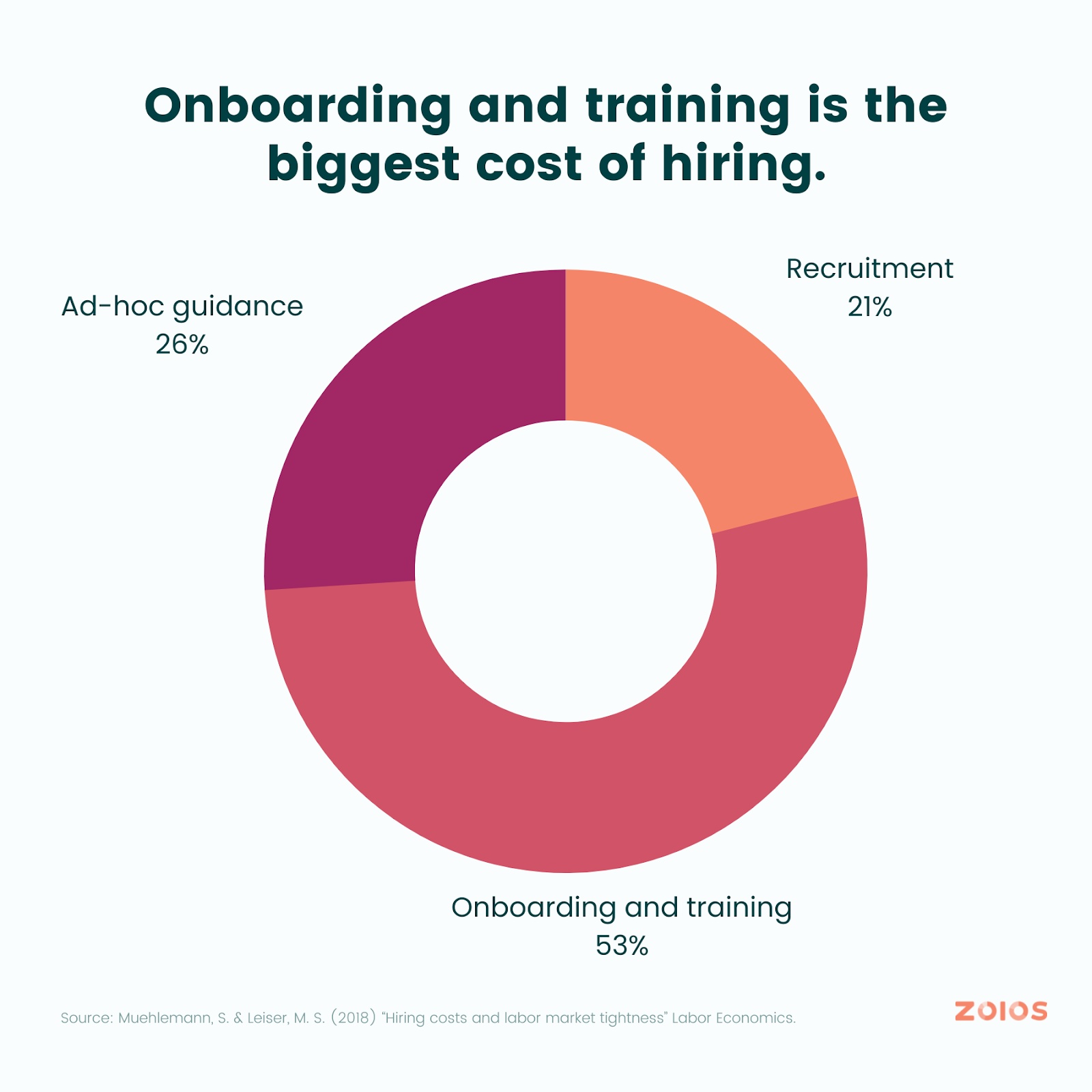
Search costs are only 21% of the total cost of a new hire.
The biggest reason onboarding and training is so expensive is the initial low productivity of the new hire.
Ad-hoc guidance and support adds up to 26% of the total cost, because the average new hire pulls colleagues away from their work for 96 hours in companies with fewer than 50 people, and 112 hours in companies with more than 50.
That sounds shockingly high. It is actually on par with previous research on the subject. Barron and colleagues (1997) found that every new hire interrupts colleagues for around 87.5 hours as part of getting up to speed.
A new hire can easily cost $40,000
The cost of a new hire depends a lot on the position.
IT specialists cost around 22 weeks of salary to hire. A retail store assistant or a mechanic costs around 10 weeks of salary.
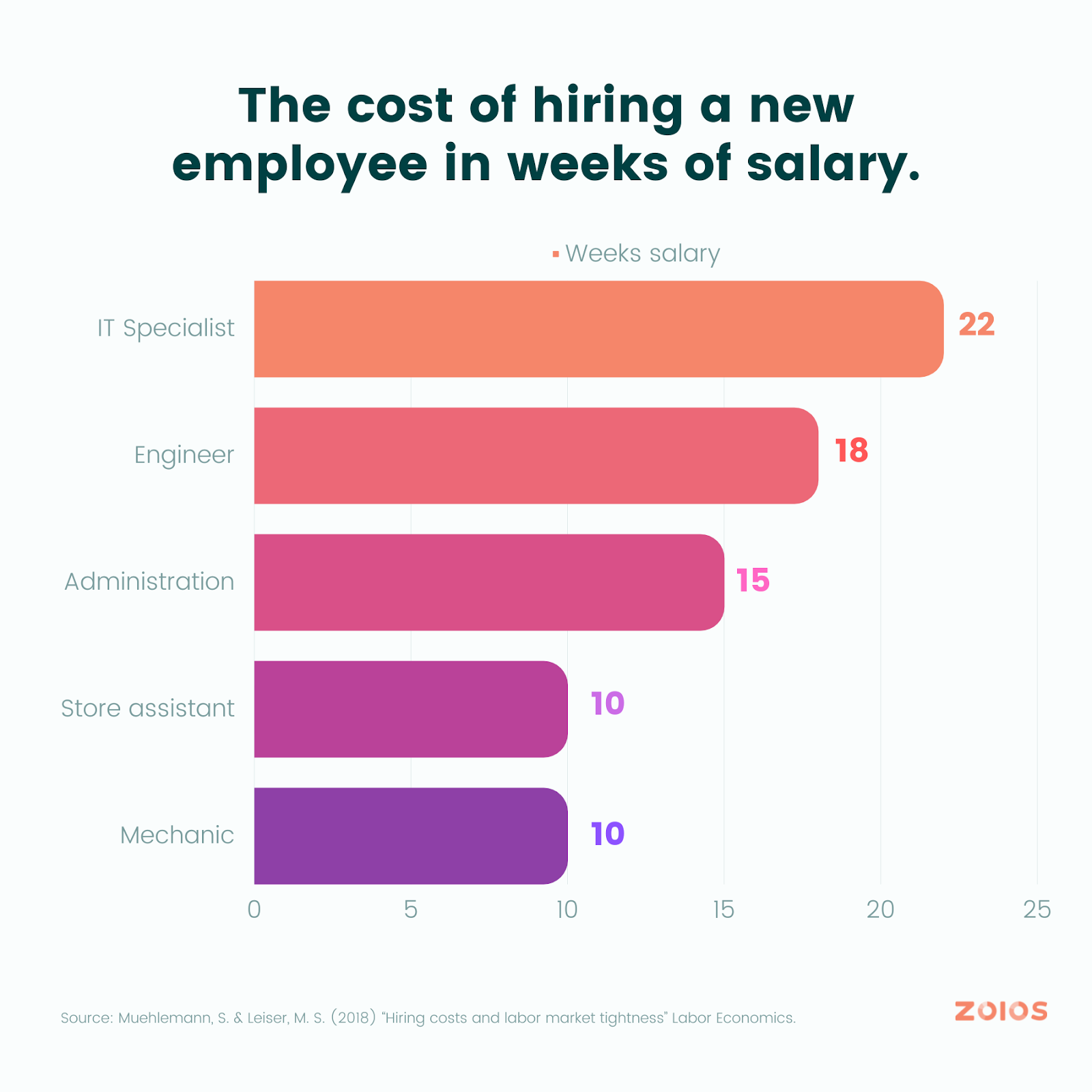
Hiring cost expressed in weeks of salary, varying by role.
22 weeks is a little over five months.
So if a person's monthly salary is a round $8,000, the total hiring cost is a little over $40,000.
The paper this is based on was published in 2018, and a lot of the underlying data is older. But competition for talented people has only become more fierce, and I would argue the costs are at least the same today, if not higher.
That makes a strong case for working proactively with retention.
Turnover cost as a percentage of payroll
You can build very big spreadsheets with advanced calculations on lost productivity, lost knowledge, time-to-fill and vacant role costs.
You do not need to do that.
The easiest way to estimate the cost of turnover is to look at how many people you actually lose every year, and calculate what it costs to refill those positions.
Imagine a 100-person company with a normal turnover rate of 25% per year. That is 25 people leaving every year.
We already know that a leaver costs around five months of salary in knowledge-heavy positions, and two to three months of salary for less specialized roles.
So if the average wage is $6,000 per month, the per-person turnover cost is $30,000.
25 people leaving means turnover is costing you $750,000 per year.
You cannot have 0% turnover, at least not sustainably. But companies should strive, and invest, to bring it down.
How can you decrease turnover costs?
Studies from Gallup have looked at data from 52 industries and over two million people to understand how engagement impacts retention.
Teams in the top quartile of engagement have:
- 65% less turnover
- 37% less absenteeism
- 22% higher profits
- 10% higher customer satisfaction
Compared to teams in the bottom quartile.
Those are the results we all want.
Increasing engagement is clearly one of the most important factors, if not the most important, for retaining more people.
The true cost of a person
You can calculate the true cost of a person on payroll in many ways.
What are you trying to achieve? If the goal is to make a business case for investing in well-being and engagement, the model in this post is enough.
If you are doing a budgeting exercise, you would also factor in office costs, equipment, lunch, upskilling and so on. That is a topic for another time.
Want help making the case?
If you want help making the case to your CFO, book a demo with me. I would love to help you with our tools and ROI calculators.