


Understanding and getting the employee life cycle right will help you find and retain the right people for your organization. By understanding each phase, you can guide your people through their career goals, increase engagement, and extend their journey with you.
What is the employee life cycle model?
Before we jump into the model, let's get the difference between the employee life cycle and the employee journey straight. The employee journey is the professional path a person takes inside your organization, from the moment they start looking for a job to the moment they leave. The employee life cycle is just a model for describing that process. It is sometimes called the People and Culture life cycle. It is typically broken down into six stages. Often, employee experience is also used as a synonym for the complete journey.
The model can differ slightly in the number of stages and their characteristics, but you will find that the journey often follows the same pattern in most companies.
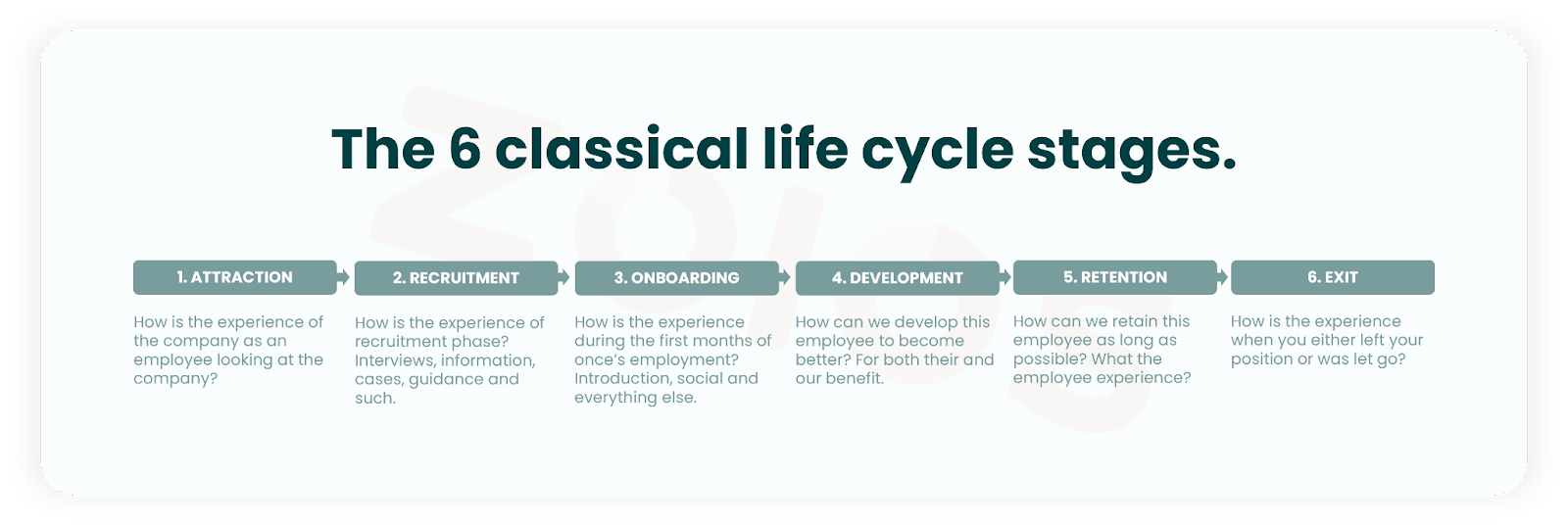
Overview of the 6 classic life cycle stages.
The model helps organizations visualize each stage of the life cycle. That makes it easier for People and Culture and leaders to work proactively with engagement strategies in each stage. As a People and Culture professional, you might notice that your people thrive in the early stages of the model, but engagement seems to lag in the later ones.
What do the 6 stages of the model contain?
The most widely accepted employee life cycle model contains six stages: Attraction, Recruitment, Onboarding, Development, Retention, and Separation.
It is proposed as a linear model where the person exits one phase before entering the next. At Zoios, we don't believe this is quite right.
We agree that Attraction, Recruitment, Onboarding, and Separation are linear phases that someone enters and exits inside a defined time frame. Development and Retention are different. They cannot be viewed as linear, since the work to develop and retain people is a repeating cycle of many activities, with ups and downs, different paths, and very different experiences for different people.
So we propose a model with five phases that combines Development and Retention into one circular phase containing the following sub-phases: Well-being, Performance, Development, Salary, Promotion, and Maternity. We call this phase The Myriad, referring to the many different activities involved. We emphasize that this is a repeating cycle that ends only when the person enters the last phase, Exit.
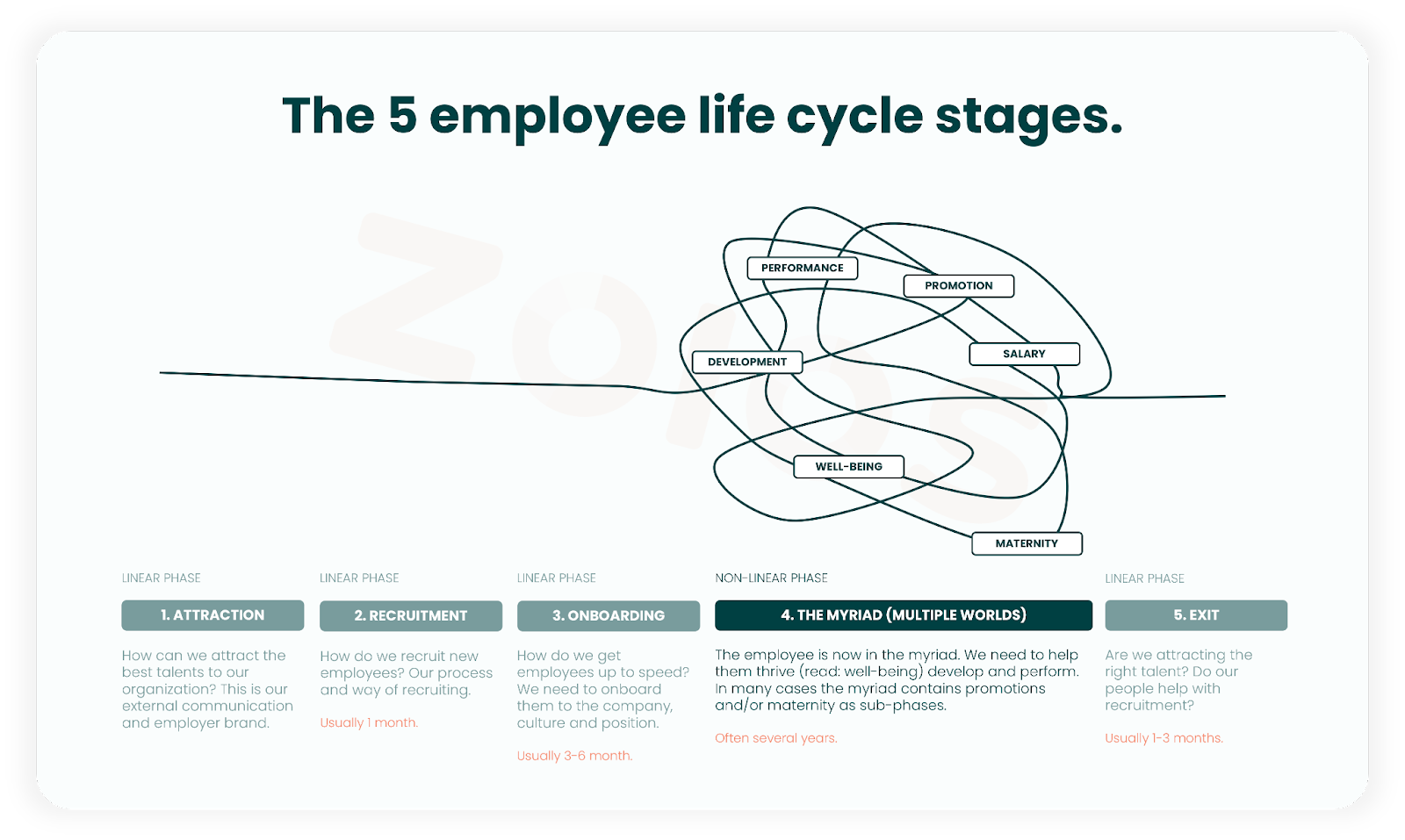
Our proposed employee life cycle model.
What defines each phase?
1. Attraction
Attraction is the first step in the life cycle. It begins even before you have your first contact with a potential candidate. This step is about attracting the best talent for your organization, and it starts with a strong employer brand.
As an organization, you can do a couple of things to position yourself as a great workplace and improve talent acquisition.
First and foremost, people will be looking for a job that fits their interests and level of expertise. Your organization is most likely not the only one offering that job.
This is why employer branding matters. It is your opportunity to stand apart from competitors and show why the right candidate should join your company.
Clear value proposition
Candidates are often intrigued by the history or vision of a company. So define a strong, clear value proposition, not only for your customers but also for potential job candidates. What is the history of your company, and what makes it unique?
Measure eNPS
eNPS measures, on a scale of 1 to 10, how likely a person is to recommend your workplace to friends or family. If they score low, you risk that they will speak badly about the workplace. If they score high, they are likely to speak well about your company and promote it as a happy workplace, improving your employer brand. Keeping track of this score is an excellent tool for ensuring your people help attract new talent.
Make sure the benefits are real
Make sure that potential candidates know about the benefits you offer. It could be medical insurance, paid vacation, or strong retirement programs.
Show your brand on social media
Social media is a great way to create and improve your employer brand. Here you can showcase core values, vision, culture, and social moments such as team events.
Try different platforms. LinkedIn is not the only one. Instagram and TikTok can also have a meaningful effect on your employer brand.
2. Recruitment
Recruitment is the first direct contact with a new person. This phase is about finding and screening candidates and ultimately finding the one who is the best fit for the position, the team, the leader, and the company.
Get referrals from your colleagues
You can search for candidates through traditional job ads. Also try your internal network. Ask your existing colleagues if they know someone they think would be a good fit.
You can also consider paid referral programs, where you offer a monetary reward if someone refers the right candidate. This can be a great tool for engaging your people in helping you fill a position. There are pitfalls to be aware of, though.
When people are dealing with a monetary reward, they might be more motivated by the reward than by finding the right fit. So you must have a well-trained, professional recruiting team that can filter out the wrong candidates, even when a colleague has referred them.
Personality and talent tests
The use of personality and talent tests is winning popularity. Examples include Predictive Index, Gallup's StrengthsFinder, or FirstMind's talent test.
These tests are great for exploring how the candidate will fit with the rest of the team and whether their profile matches the tasks of the job. For instance, you might not want to hire someone for bookkeeping who hates details, loves creativity, and gets energized by exploring new ways to solve problems.
Be honest and transparent
Honesty and transparency are key in recruitment. Let candidates know they can trust you and that you are not holding anything back. If you are, they will sense it.
Be clear about tasks, expectations, and responsibilities. Set clear expectations for what they can expect from their new job. This will also help you hire someone who will not resign quickly, because their expectations of the job will match what they actually get.
Ask for feedback
Don't be afraid to ask candidates for feedback on how they experienced the recruitment process. It is valuable information that can help you improve and ensure candidates have a good experience with your company, even if they were not hired.
3. Onboarding
The next phase is Onboarding. When the candidate with the best fit has signed the contract, the onboarding process starts. Starting a new job is stressful, so remember to provide vital support throughout. Onboarding typically lasts between three and six months. Solid professional skills don't translate into strong social skills, so keep an eye on how your new colleague thrives in the social environment too.
Don't forget pre-boarding
Pre-boarding is similar to onboarding but starts before the first day. It is important because it lets the journey begin before they are formally with you. It can help foster loyalty by showing that you are excited to see them. You can invite them for a coffee at the office or to a team event. That way they meet their new colleagues and get a taste of what they can expect. You can also send light reading with useful background that will help them on day one. Make sure to let them know you are available for questions before they start.
Set clear goals and expectations
Be clear about what you expect from your new colleague. It can be very stressful to be placed at a desk without clear goals for what you need to learn and exactly what you are expected to deliver. Make a detailed plan together for at least the first two weeks, preferably the first months.
Have weekly 1:1s in the onboarding stage
Weekly 1:1s during onboarding are an excellent opportunity to check in and make sure everything is going smoothly. They are also a great chance for the new colleague to ask questions and give honest feedback on how their onboarding is going.
Consider a buddy program
A buddy program can help establish a sense of psychological safety for the new colleague, since the buddy can help them navigate the company culture.
Some new colleagues may be afraid to ask questions for fear of looking incompetent. A buddy can be a great way to address this by being available for questions they might not want to ask their leader.
A buddy can also show them around on the first day and introduce them to other colleagues. They can help with questions where the answer is not in the employee handbook.
Onboarding is a shared project
Even though a buddy program and the other initiatives above can help a lot, it is important to remember that onboarding is a shared project across the team. Create a culture of inclusion where new colleagues feel welcome quickly, so they can thrive and start performing.
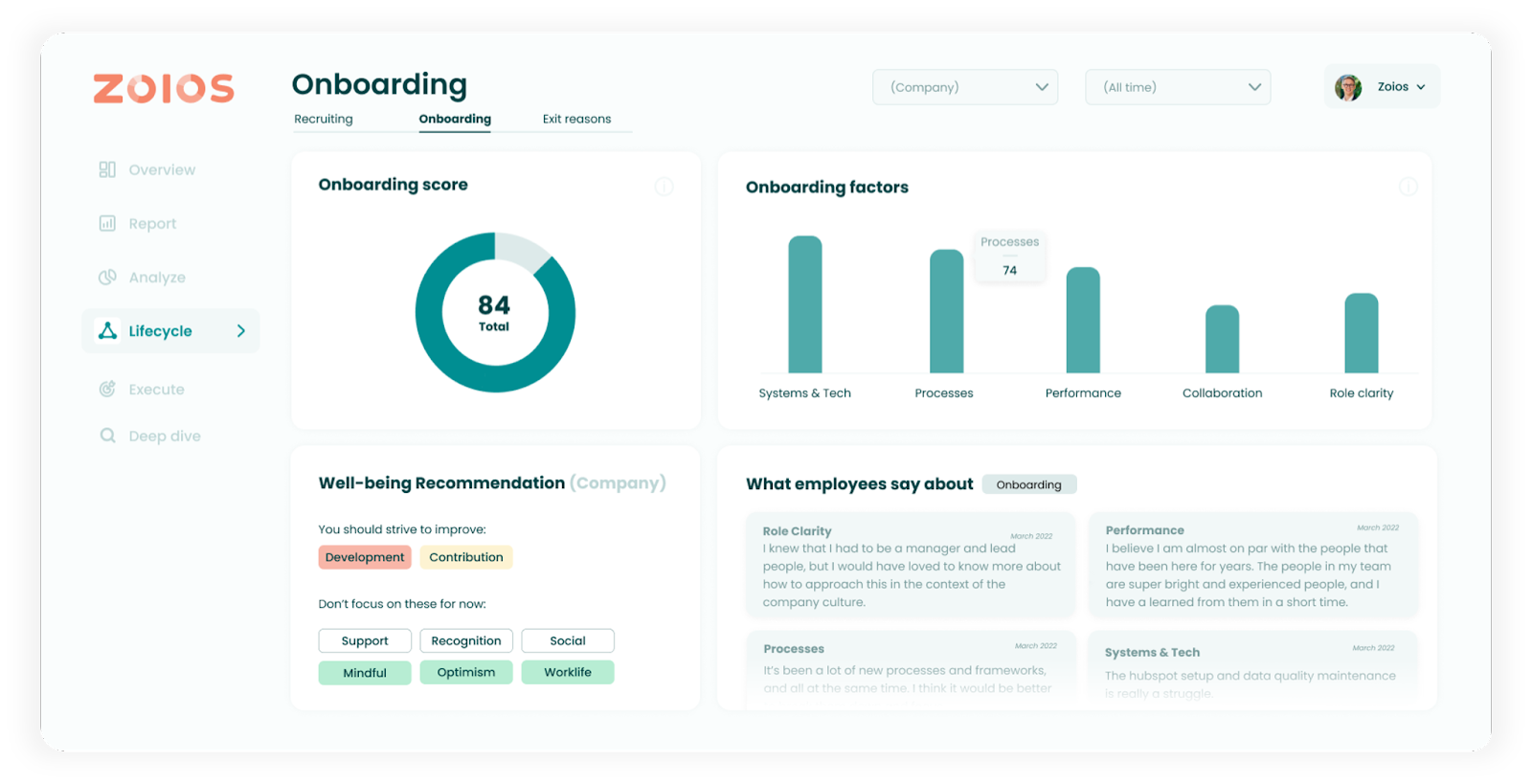
An onboarding overview in Zoios People Analytics.
4. The Myriad (development and retention)
When people leave the onboarding phase after three to six months, they enter the phase we describe as The Myriad, due to the many activities they will experience here.
This phase is often divided into two phases (Development and Retention). That division implies that Development must end before Retention begins.
We have chosen to combine them, not only because we believe this phase is highly repetitive, but also because most people will experience it very differently from one another. The earlier phases tend to follow a standard pattern, giving most people a similar experience. After onboarding, recruitment and onboarding are usually quite standardized, but the rest of the journey often differs a lot, depending on factors such as promotion, parental leave, development, and so on.
When people enter this phase, their career and journey through the company take different paths. We have therefore included six sub-phases in The Myriad, which allows for a more precise description of the life cycle. The sub-phases are: Well-being, Performance, Development, Salary, Promotion, and Maternity.
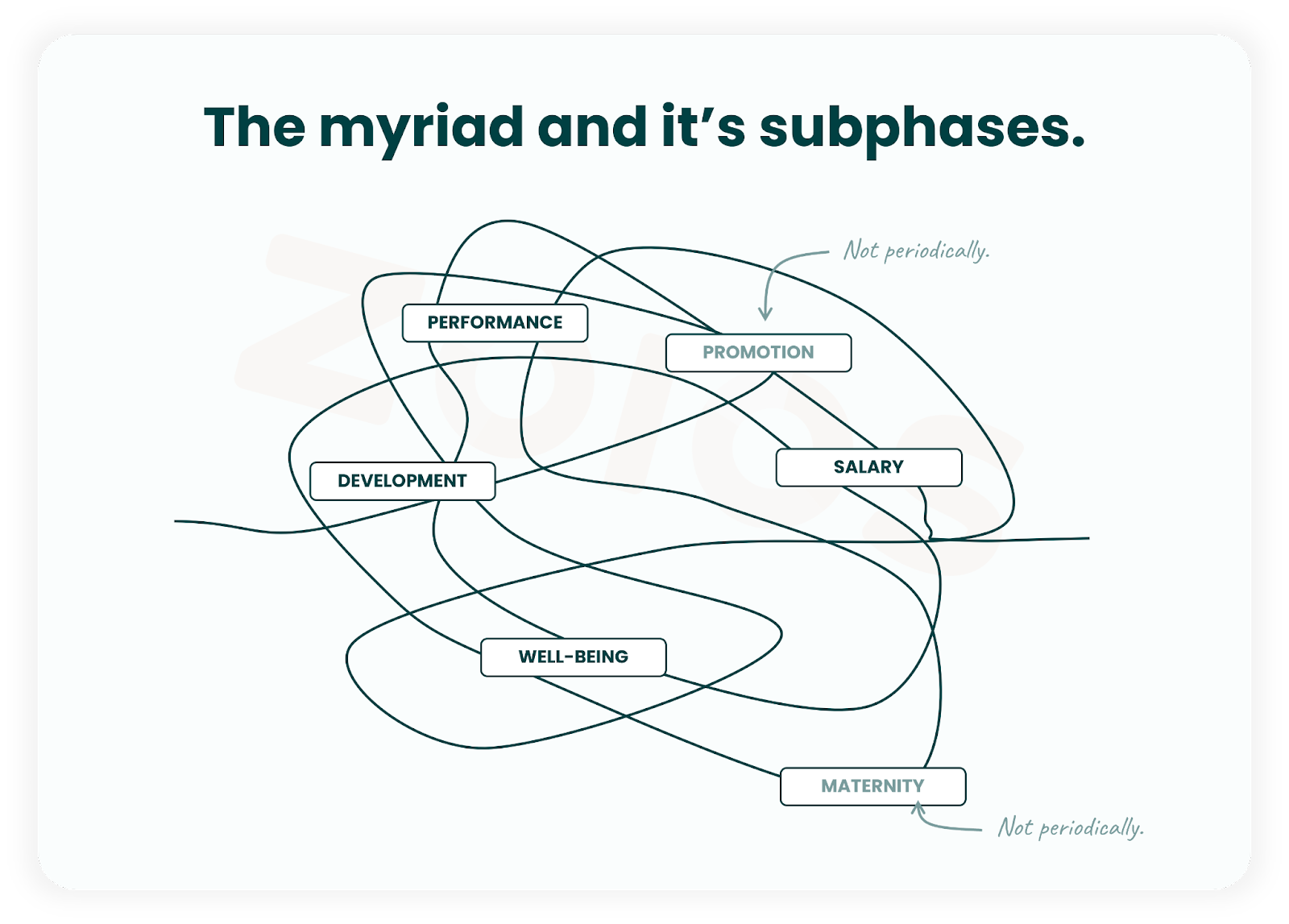
The Myriad consists of many repeating sub-phases.
These sub-phases are tightly tied to development and retention, and form an important part of talent management in any organization. The reason retention is not explicitly mentioned is that great retention is the result if you succeed with the sub-phases.
So the point we want to emphasize is this: retention is not the goal. People who thrive and perform are the goal. If you succeed there, you will undoubtedly get a great engagement rate.
Leaders can work effectively with the sub-phases through 4 different conversations
You can work with the sub-phases in several ways. A great method is to schedule regular conversations with your people. We recommend that most leaders have these four different conversations with their people.
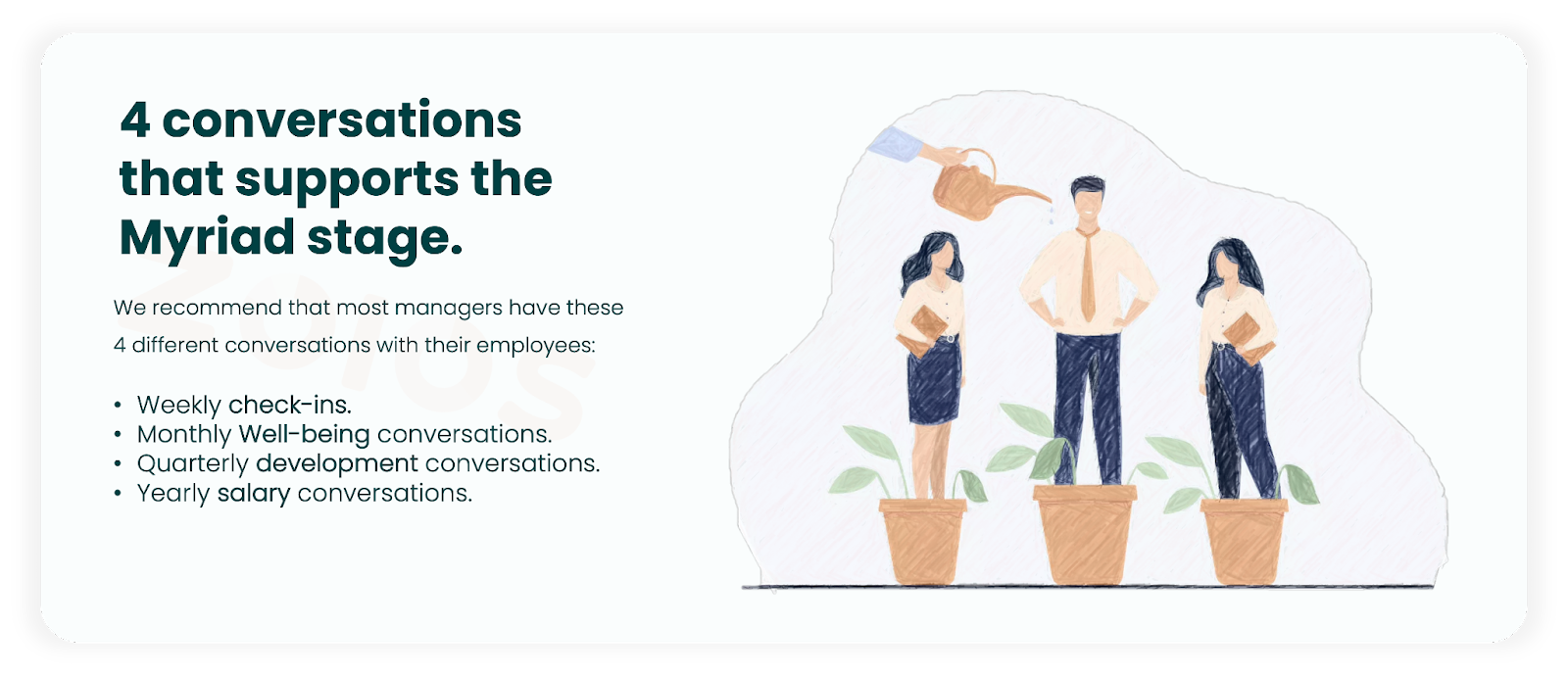
Four conversations that support the Myriad stage.
Frequent check-ins
The first conversation is a check-in on tasks, to make sure they have the guidance, support and information they need to do their job. Try open questions like:
- What can I help you with?
- What do you need from me to complete your task successfully?
Avoid yes-or-no questions like "Can I help you with anything?" The spontaneous answer is often "no", even when the person could use your support.
These check-ins should be weekly, or more often.
Talk about well-being
The second conversation is the well-being conversation. Touch base on whether the person is thriving in their position, what could be improved, and how they feel in general. It is a good idea to have these conversations monthly, so you can follow up on agreements you made at the last meeting. Don't talk about projects and tasks unless it is highly necessary, or if those topics are linked to the well-being concerns.
Help your people draw a development plan
The third conversation is the development conversation. Dive into the areas where the person would like to improve. Explore ways of making a suitable, realistic plan that fits everyone's needs and wishes. The leader gives honest feedback and offers input on where and how the person can improve and lift performance.
It is important to listen to their wishes and create a development plan they find realistic and exciting. Try to set clear goals to work towards. It can also be great to offer further training, seminars, online courses, or mentorship. Show your people that you take their career development seriously.
These conversations should happen quarterly.
The yearly salary conversation
The fourth conversation is the salary conversation, which most have once a year, where you discuss compensation. Everyone knows this one, but it is a big part of the experience, especially if it is handled poorly. Consider how the person experiences this conversation and try to see it from their point of view.
5. Exit
All good things come to an end, and eventually a person will leave you. The keyword here is to end the relationship on a good note. The best case is that they will go on to promote your company and strengthen your employer brand by telling others how great a time they had working with you.
Conduct exit surveys
It is crucial to understand why someone left. Maybe they went to pursue new career paths. That is totally fine, and there is nothing you can do to control that.
On the other hand, the person may have left because of poor work culture, leadership, or work-life balance. This is valuable information, and you should do your best to collect it through exit interviews or surveys.
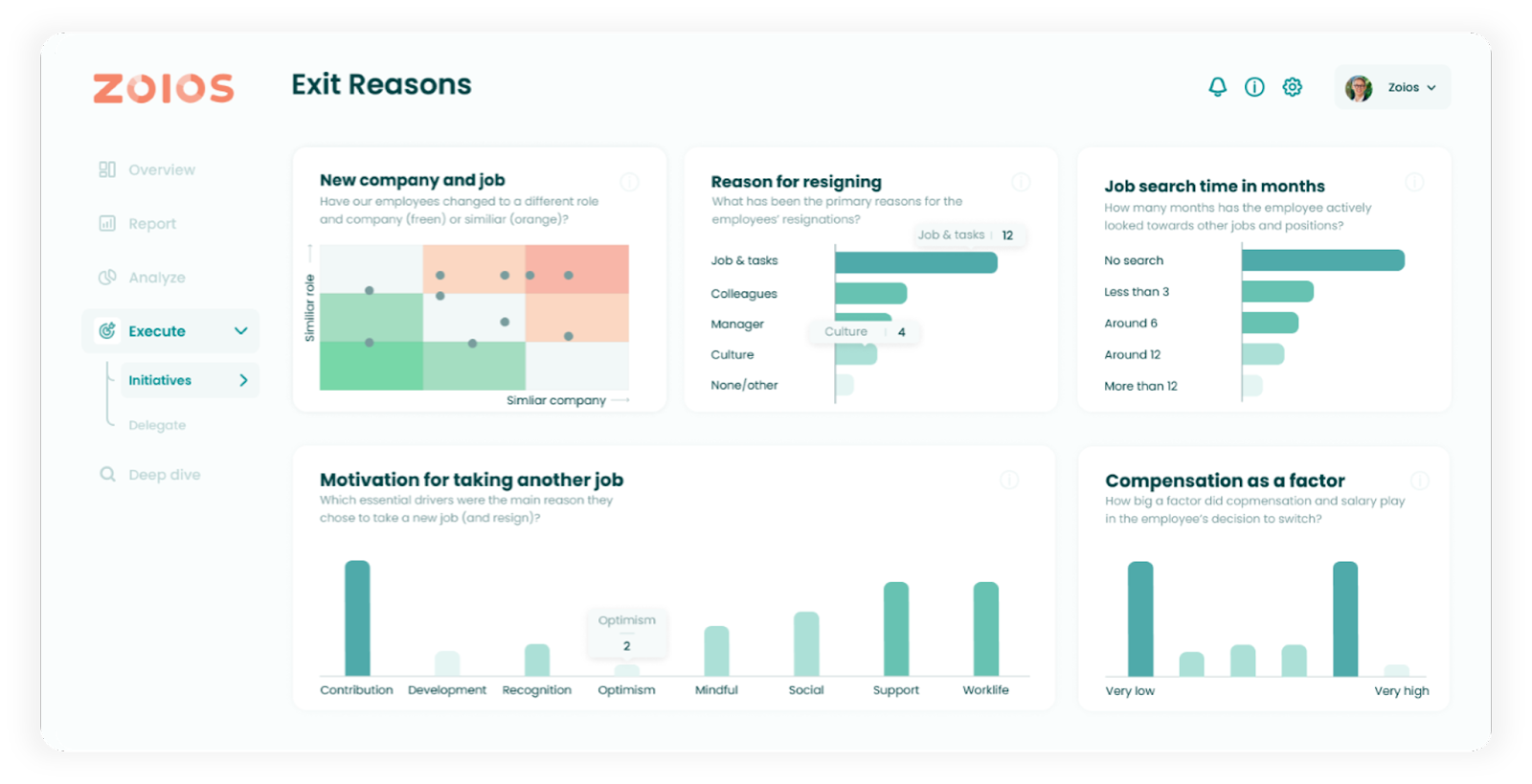
An example of how exit survey data is displayed in Zoios.
Nurture team morale
When a colleague leaves, it affects the rest of the team. There is a risk it can hurt the team culture, and in the worst case it can make others consider leaving too. So it is important to nurture morale and positivity in the team. Highlight that the remaining colleagues have a future and development opportunities in the company.
Why mapping the journey is crucial
Now that we have the model straight, let's look at why this matters. The employee life cycle describes the journey from the employer's perspective. That is great. It gives you an overview of the initiatives and opportunities you provide for someone in each step.
Mapping the employee journey is about something else: understanding how the person experiences each step in the life cycle. So it is not about listing what happens in each stage. It is about taking your people's view and understanding how they feel in each stage.
For example, you might have great processes for setting goals in onboarding and think everything is fine. But these goals may be too ambitious or ambiguous and make your new colleagues feel stressed or uncomfortable.
By mapping the complete journey, you create a strong visualization of the critical touchpoints and can work proactively to improve each stage that might be lagging. In other words, it is a crucial step in successful succession planning.
Include your people in the journey mapping
It is essential to include your people in the process of creating the journey map. They will provide the data you need, and including them shows that you care about their well-being. Of course, this is only beneficial if you actually take action on the data. If you don't take their feedback seriously, it will create dissatisfaction.
Measure your progress
As soon as you have a clear overview, you can measure your progress and ensure you are improving. It is crucial to follow up on initiatives and confirm they have the desired effect. Without that, you are groping in the dark.
This will lead to better-performing, more satisfied, more engaged people. The downstream effect is a high-retention workplace, and that is what we all want.
It can be expensive to hire someone new, so investing in retention is crucial for your organization's success.
How to map the journey and improve the stages
Journey mapping asks: what is the experience like for our people? The experience is not the process that happens in the organization's systems. For example, "they apply for the job, get hired, have weekly 1:1s, and have one yearly salary interview." That is not mapping the journey.
Think about the stages from their perspective. What are the challenges they might face? Don't be afraid to include the emotions your people might feel in your journey map. What is it like to be promoted? Is it an unsettling feeling, or a confidence boost? How does the first week at a new job feel? Welcomed or a bit frightened?
Pay attention to the stages or touchpoints that are important in your organization, and give those particular focus when you create the map.
7 tips for mapping the employee journey
Here are seven points of awareness to help you succeed with the mapping.
Decide on your why
Always start by asking yourself: why am I mapping the journey? There is no correct answer, and the answer will differ from organization to organization. What would you like to understand, and why? Maybe you want to know why your onboarding seems to be lagging. Maybe you want to improve retention.
If you skip this step, you might end up with the wrong focus and move in the wrong direction.
Understand the journey from your people's perspective
This is crucial. If you cannot view the journey from their perspective, the map makes no sense.
Ask questions like: how do they feel when… For example, how do they feel when they apply for the job? How do they feel when they get new responsibilities?
Emotions are involved everywhere. People don't simply move from one stage to the next. From accepting the offer to starting onboarding can evoke emotions. Maybe the salary negotiation was stressful, or didn't go as expected. Include emotions in the map.
Use the data you have, and collect new data
Some organizations have tons of data they can use for journey mapping. They have collected it through various People and Culture or people analytics systems.
If you don't have this data, don't despair. You may not have the complete dataset you need, but consider how you can collect it, and focus on what you already have.
If you need help collecting more data, look at a people analytics platform.
Gather feedback in a way that encourages honesty and trust
If you don't have access to people analytics or automatic survey tools, you will have to invest substantial time in collecting and analyzing data.
Start with qualitative interviews, where you try to understand how people feel in each stage. It is about hard truths, so don't be afraid to hear them. Encourage honesty and trust. Ask open-ended questions so you don't bias answers. Don't say: "I heard you are not thriving, is that because…?". That probably won't get you an honest answer.
Be aware of when in the life cycle people start to quit
This can be a great indicator of which stage you should spend extra time mapping.
What were the original promises that were made?
Consider the promises you made when you hired your people. Make sure you have lived up to them. Pay attention to feedback like "I wish it were different" or "I wish others understood the brand image". A lot of those signal that you didn't live up to the promises.
Words like "frustrated" or "disappointed" should catch your attention. Get back to people and ask them what they expected, and what they heard you promise.
Make sure to take action
When you ask people for feedback, they expect you to take action. So make good use of the feedback and create a plan. If you don't, it destroys trust.
For example, a typical problem is that people feel they attend too many unnecessary meetings that could have been an email. If you don't take action after being told, it creates anger and frustration.
So come back to your people after collecting feedback and tell them what you are going to do, and how. Highlight that creating the best experience is a shared project, and you hope everyone will participate.
When people start working with you on this, it snowballs. More will join in if they feel action is being taken and they can see improvements. Build the journey map together with them, and treat them in a way that earns honest answers. Don't forget to prioritize: what is most important right now, what can be easily fixed, and what might take more time to improve?
The journey is not the same for every person
When mapping, many People and Culture professionals say "great, we will make a journey map that fits everyone." But people are very different, and one map probably won't fit all.
A way around this is to use personas and map the journey for the typical two or three personas you see in your organization. This is a great way to narrow the journey and get more specific. Think about each persona's goals and pains. You can also do this from a diversity and inclusion perspective, or think about how the journey looks for someone who grew up in your organization versus someone who came from the outside.
Are you ready to map the journey?
If not, please reach out. We would love to help you get started using our employee journey template. We hope this makes it easier to design a better experience. Also feel free to share if you have any ideas on how to design the journey.