


All good things come to an end, and eventually, some of your people will leave. It can be a voluntary exit or an involuntary one. Either way, it is vital to ensure a smooth goodbye. To do that, it is essential to be aware of the ethical and formal aspects that relate to a good exit, both for the leaver and the company.
In this post we cover what good offboarding is, how to accomplish it, and what to be aware of in the process.
What is offboarding?
Offboarding is the final stage in the employee lifecycle. It wraps up the entire employee experience. So even though it is the last step before the final goodbye, you must take it seriously to ensure the complete experience.
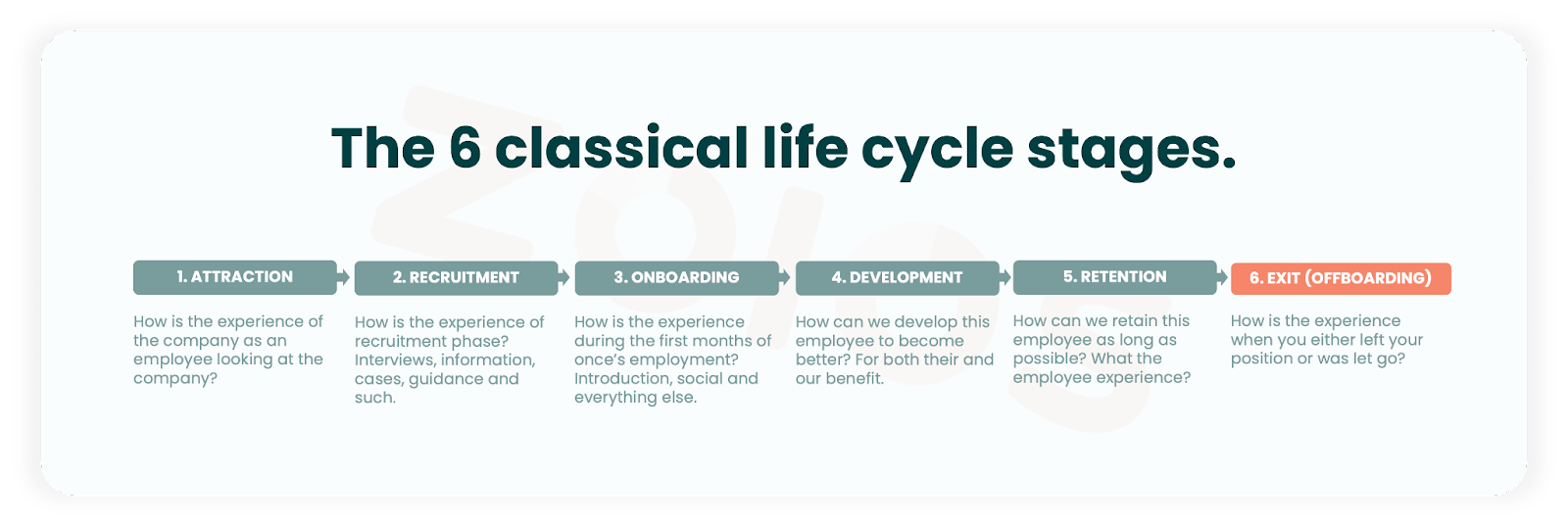
Offboarding is the final stage in the employee lifecycle.
Ensuring a great employee experience is the first part of a good offboarding process. The other part is about learning from the exit. Why did the employee leave, and could anything have been done to avoid that? A good offboarding process gives you valuable insights into how to improve the whole employee experience and stay attractive for the people who remain.
A good offboarding process also minimizes the impact of an exit on the company by ensuring the right knowledge transfer, task handover, and so on.
How do offboarding and onboarding compare?
While onboarding (or for some organizations preboarding) is the first point of contact after the recruiting process, offboarding is the last point of contact before the final exit. Onboarding is about creating a great welcome experience. Offboarding is about making a great goodbye experience.
These two steps are somehow opposite, but they have to be treated with equal care. Just as you do not want your employee to walk into the office on their first day as if nothing happened, you do not want them to leave as if nothing happened.
The onboarding process is, for most people, full of uncertainties. What are my exact tasks, how do I approach my colleagues, how do I find my fit in the organization? Likewise, the offboarding process can be a period of uncertainty. The leaver wants to ensure a good separation, while at the same time feeling both excited and anxious about their next role. That can cause a lot of different emotions to handle, so take that into account when you plan the offboarding. The same goes for the employer, who is left wondering why the person really left.
Why is good offboarding crucial?
Five reasons it matters and why it is worth taking seriously.
Ensure a complete employee experience. We often hear that the first impression is the most important, and that is still true. But the last impression might be just as important. We tend to remember not what people say, but how they make us feel. If the offboarding process is badly organized and carelessly executed, it leaves us with a bad final impression that, in the end, makes us remember the bad feelings. Instead, the offboarding should leave the employee in a positive state of mind.
Mind your employer brand. When you ensure a magnificent experience from recruiting to offboarding, you also take care of your employer brand. You don't want your former employees telling friends and family about how confusing the offboarding was and that they weren't offered an appropriate goodbye. Do the opposite. Let people leave with grace, and show them you appreciated their work. The chance that they leave as an ambassador goes up significantly.
Attract boomerang employees. Boomerang employees are those who leave the company and return, typically after a couple of years. Hiring boomerangs has real benefits, and it becomes much easier if they had a good offboarding experience that, for example, added them to an alumni network and kept the relationship alive. Boomerangs ramp up quicker than a completely new hire because they already know the culture, the product, and often the work itself.
Minimize the impact on the company. Offboarding is not only about ensuring a good experience for the leaver. It is also about a good experience for the company. It is always costly when a person leaves: lost knowledge, recruiting and training, and potential damage to culture if other employees start to consider leaving as well. A good offboarding process minimizes that impact through carefully planned handovers and knowledge transfers, and through clear communication so everybody knows how the process will run and who will handle the leaver's tasks until a replacement starts.
Improve retention rates. It is always sad to say goodbye to a valued person. On the bright side, a good offboarding process helps you learn from the incident. So do your best to understand why the employee left, and what you can do to retain those who stay.
How to streamline your offboarding process
Building a standardized framework for your offboarding process is crucial for making it a success and ensuring that everyone gets an equally good experience with their exit. Step one is creating a process that fits your organization and its goals. Below are points of awareness when you create that framework.
Conduct exit surveys and interviews
This is the most critical part of securing that you learn and improve. Combine the two formats.
First, do an exit interview with the leaver. It is a qualitative conversation that will help you understand the unique reasons why that specific person chose to leave. Listen more than you talk. Don't try to defend the company. Strive to understand the reason. Always ask open-ended questions, and don't let your assumptions about why the person left show.
When conducting exit interviews, be aware that since the employee is not anonymous, you cannot be sure they dare to give their honest opinion. They might be afraid that speaking the truth will hurt their future relationship with the company or make it harder to ask for referrals. Have an informal meeting and emphasize you don't judge them.
Despite your best efforts to encourage honesty, getting the leaver to fully speak their mind might still be difficult. So also conduct an anonymous exit survey. You can either formulate one yourself or use an existing HR tool that ensures 100% anonymity.
Zoios has a built-in function for this kind of anonymous exit survey. The picture below shows an example of how the results look. It can help you answer questions like:
- What was the motivation for choosing a new job?
- What was the reason for resigning?
- How big a role did compensation play in choosing a new job?
- How similar is the new job to the old job?
- For how long did the employee search for a new job?
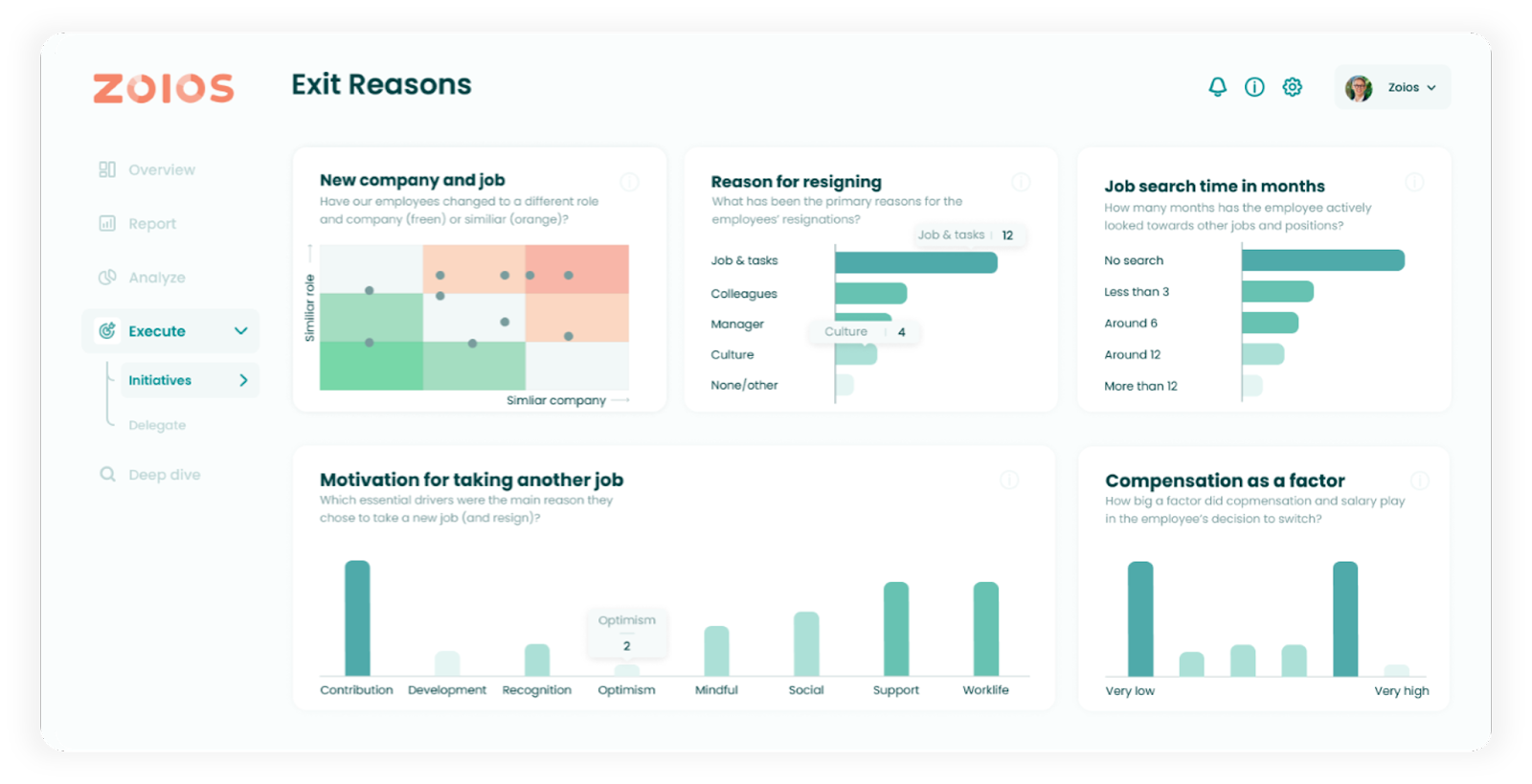
An example of how Zoios surfaces exit reasons.
If you do both exit interviews and exit surveys, you are well prepared to learn from the exit. If you have also been doing frequent 1:1s with the employee during their employment, you can use that data to look for patterns that might have affected the decision. Combining all three sources gives you a strong picture of why someone left, which can be used to improve engagement and experience for everyone else.
Secure the leaver's knowledge and hand over tasks
When someone leaves, it is hard to avoid a loss of knowledge. There are typically two types. Explicit knowledge can be documented and transferred without much hassle: information about clients, ongoing projects, and so on. This should be written down and handed over to the next person, ideally as an ongoing practice throughout employment, not a last-minute scramble. Tacit knowledge is unspoken and highly embedded in the culture. The way to preserve it is to create an active culture that shares and reflects on this knowledge, which makes it easier for new hires to pick up.
Design a deliberate process for the task handover. Identify the critical aspects that need to transfer, and make a detailed plan for how and when a colleague or new hire takes ownership.
Can you keep the employee's network somehow?
When someone leaves, the company often loses access to their network. So consider how you can stay connected to it. Get the leaver to map their network, and ask if they can introduce relevant contacts to a colleague or a new hire.
Wrap-up
For an offboarding process to be successful, it has to be seen both from the leaver's perspective and the company's. First and foremost, offboarding should ensure a good experience for the person leaving, so they can look back on their time with the company with joy. People deserve this from an ethical point of view, and it is also beneficial to the company in terms of employer branding and the potential for a boomerang return. From the company's perspective, it is essential to understand why the employee left and learn from it. And the company should strive to minimize the impact of the exit on culture and on the handover of tasks.