


The term full life cycle recruiting refers to the entire process of finding new employees. The process consists of six steps:
- Preparing
- Sourcing
- Screening
- Selecting
- Hiring
- Onboarding
In many organizations, these steps are split among various people. In others, you will find that one person handles all six steps. When one person is in charge, it is called full life cycle recruiting (sometimes also end-to-end recruiting or hiring cycle). That person is the full life cycle recruiter.
In traditional recruiting, each step is handled by a different person. The hiring manager might write the job post, HR will do the screening, and a recruiter helps with interviews. There are advantages to that, and disadvantages. Likewise, having one person in charge of the whole process has pros and cons.
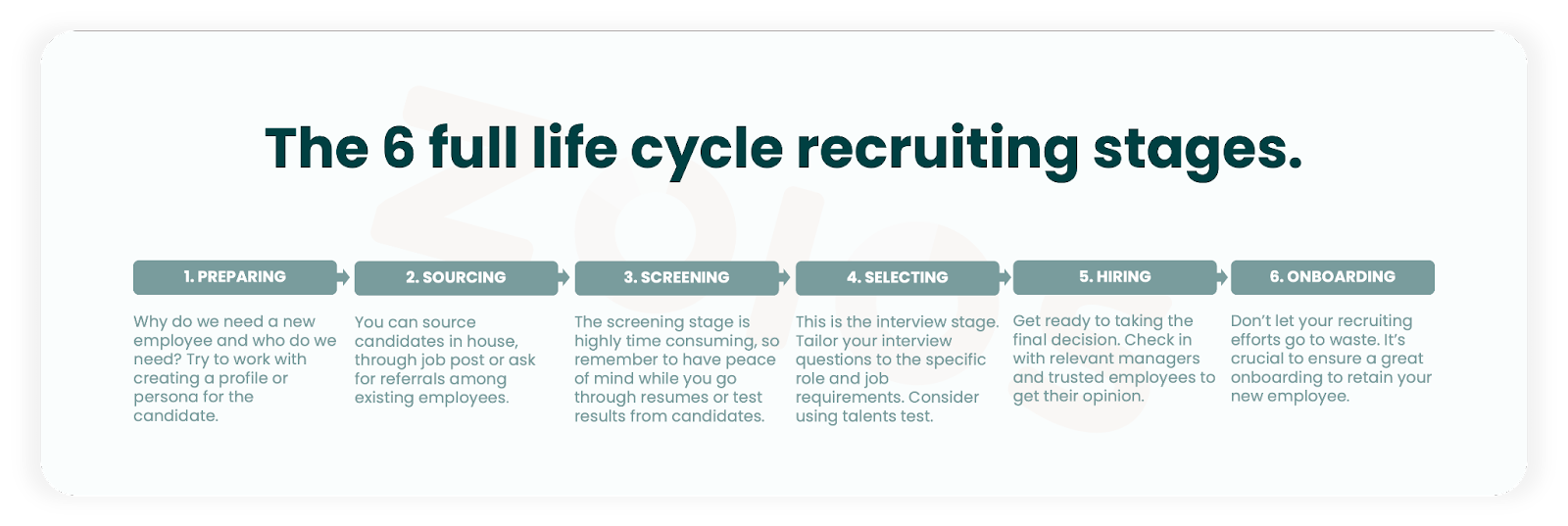
The 6 stages of full life cycle recruiting.
Who uses full life cycle recruiting
There can be several reasons for using full life cycle recruiting, and there is no single correct answer to whether the standard hiring process or full life cycle recruiting is better. It depends on the circumstances and the specific need of the company. That said, you will often find smaller companies using full life cycle recruiting because they may not have a large HR department. Larger companies sometimes use it too, particularly when looking for someone who will be a pillar for the business's success, where it helps to have one person with the full picture.
Pros of full life cycle recruiting
Clear responsibility. A full life cycle recruiter is responsible for all six steps. There is no doubt about who does what. The recruiter has a complete overview and can manage each step according to their preferences. (As you can imagine, this can also be a con. More on that below.)
Smooth experience for the candidate. The candidate experience starts in recruiting. Giving a potential candidate a pleasant experience from the first contact is crucial. This is more smooth and coherent when one person owns all touchpoints. Having only one point of contact makes it easier to build a real relationship.
A quicker, more efficient process. The chance of delays drops when one person owns the whole flow. The recruiter doesn't have to wait on third parties, which can otherwise blow up the time-to-hire. A quicker process is a better experience for the candidate. It does, however, demand a strong skill set from the recruiter, who has to be able to master all six steps.
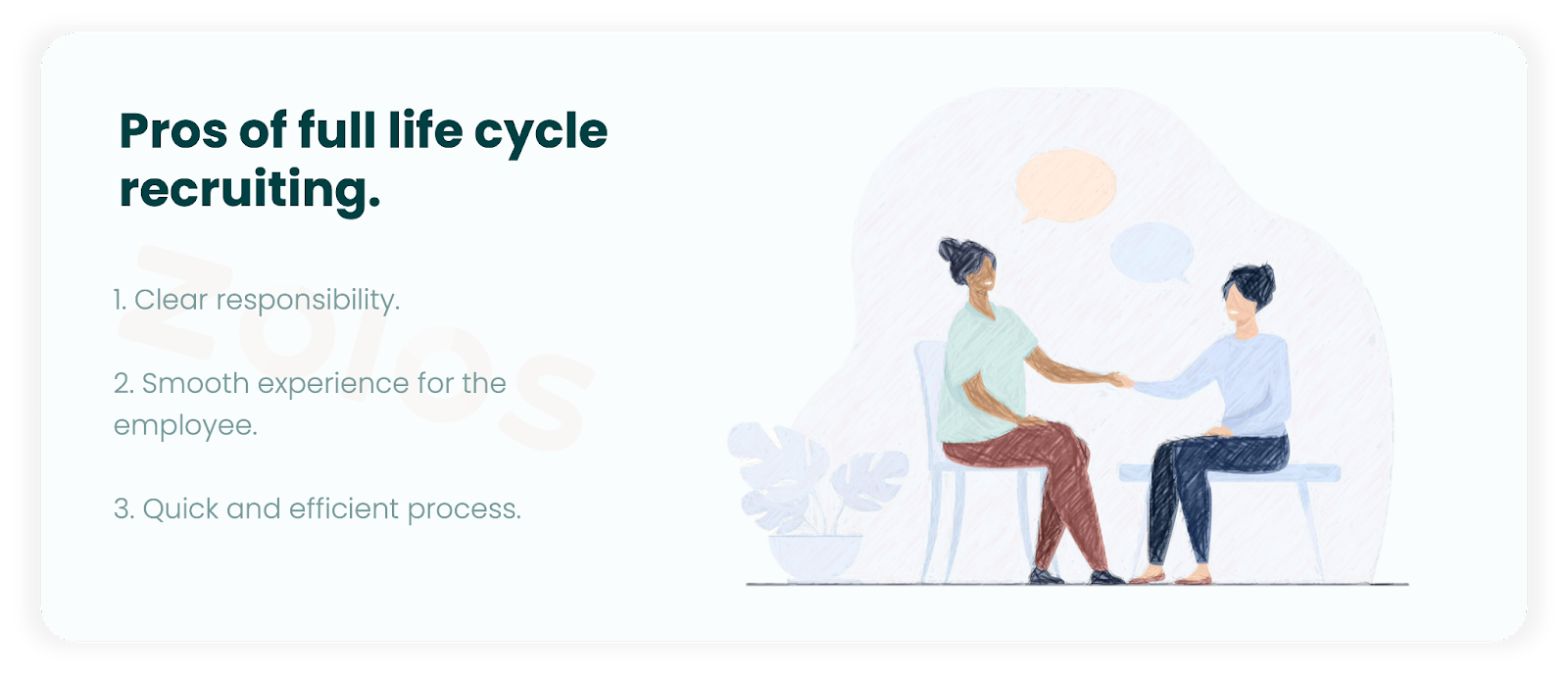
The three main pros of full life cycle recruiting.
Cons of full life cycle recruiting
Managing all stages is challenging. The full life cycle recruiter must handle both screening and salary negotiation, which are very different disciplines. That skill set can take years to obtain.
It is also more time-demanding to manage many candidates simultaneously. The recruiter is therefore limited to fewer candidates than in the traditional method, where several people are involved.
The six stages
Below is a brief introduction to each stage and what to be aware of.
1. Preparing
This is where you ask why. Why do we need a new person, and who do we need? If you are hiring for a manager, interview the manager and align on expectations.
The most important part of preparing is to deeply understand which candidate you are looking for. Which skill set is required? Which personality type would fit best? What interests should they have? Try to write a clear profile or persona for the ideal candidate. Also consider what type of education and experience you prefer.
2. Sourcing
The sourcing stage starts when you have a clear picture of the candidate profile. You can search through job posts or look in-house. Ask current employees if they know anyone who would be a good fit. This is a great way to take advantage of your internal network.
Consider whether to offer a referral reward. It can engage your team in finding candidates, but watch out for a pitfall: when employees are dealing with a monetary reward, they might be more motivated by the reward than by finding a true fit. So pair this with a well-trained recruiting team that filters carefully.
Knowing how many candidates to source is hard. It depends on how comfortable you feel with the candidates you have and the resources you have available. Sourcing and screening is highly time-consuming, so be realistic.
Take advantage of your employer brand. A well-established employer brand makes sourcing easier. Attracting the right talent is more manageable when people know and understand your values. If candidates have followed your company on social media or seen you portrayed in the media, they will be more likely to apply, because they already feel the cultural fit.
3. Screening
The screening stage starts when you feel you have the right number of candidates. The more candidates, the more time-consuming this is, so prepare mentally.
Start by reviewing resumes with the candidate profile from step 1 in mind. Consider both role fit and company fit. Compare candidates' skill sets against each other. When you have decided on the most promising ones, do a short phone interview.
It can also be a good idea to pre-test candidates by sending a case that resembles a typical work task. You see how they handle it, and they get a sense of whether they would find that kind of work exciting. That way, you avoid inviting the wrong candidates to a full interview.
After this stage, you should be down to roughly 3 to 7 candidates ready for the full interview.
4. Selecting
Before the interviews, make sure you have thought out the right interview questions. Tailor them to the specific job requirements and the personality type you are looking for. Think about which questions will give you a clear understanding of role fit. A consistent interview guide makes it much easier to compare candidates afterward. Depending on the complexity of the job, you may need 2 to 3 interviews.
Use personality and talent tests. These are increasingly common and very useful in full life cycle recruiting. Two well-known tests are Predictive Index and Gallup's Strengths Finder. Use them to understand how a candidate will fit with the rest of the team and how they will handle the complexity and pace of the work. If you are looking for someone who will work a lot independently, you probably do not want to hire a very outgoing person.
5. Hiring
This is decision time. Check in with relevant managers and trusted employees. Do a final background check and collect references from former roles. The more perspectives you can get, the higher the chance of a successful hire.
Take a structured, data-driven approach. Compare each candidate against the requirements you set in step 1, and against the personality test results. A structured process keeps you unbiased.
Communication has to be crystal clear: salary, benefits, start date. In the salary negotiation, consider how the candidate feels in the situation and what you can do to ensure a good experience from the start. Patience and listening are key.
As soon as you reach an agreement and the candidate signs, the preboarding phase begins. Don't take this phase lightly. Preboarding is great for establishing trust and engagement before day one.
6. Onboarding
When the primary hiring process and the preboarding are complete, onboarding starts. The recruitment life cycle ends here, and the employee enters the employee life cycle, where the company's onboarding process takes over.
This phase is crucial for retention. Don't let your hard recruiting work go to waste with a poor onboarding experience.
Don't be afraid to ask new hires for feedback on the onboarding process. It will help you improve and shows them you care. You can collect feedback through interviews or anonymous surveys, with the latter often producing the most honest answers.