


Leaders face a historically challenging time. Pandemics, constant competition for talent, the so-called "great resignation," increased digitalization, you name it. At the same time, getting commitment from your people and motivating them is more important than ever. How do you, as a leader, do that right now?
According to an article from Børsen, 9 out of 10 Danish managers say they try to navigate this through trust-based management. Psychological safety is also a concept that increasingly shows up as essential to succeed as a team. Research published by Accenture associates psychological safety at work with 50% more productivity, a 57% greater probability of collaboration, and 74% less stress. Which makes us wonder: is psychological safety really what is needed to succeed in this time, rather than trust? And what exactly is the difference between the two?
In this post we will explain what psychological safety is, why vulnerability-based trust is a key term in the matter, zoom in on a case from Danske Bank, and finally give you three essential tools to succeed in your organization or team through psychological safety.
What is psychological safety?
Before getting to concrete steps, it is important to understand what psychological safety is, and why it matters.
A quick search for "psychological safety" surfaces this definition from the Center for Creative Leadership: "Psychological safety is the belief that you won't be punished or humiliated for speaking up with ideas, questions, concerns, or mistakes."
It is a great definition, but it lacks some nuance. Let us unfold the term a little further, starting with a perspective from Danish best-selling author on leadership Christian Ørsted.
According to Ørsted, most Danish managers assume that informal, non-hierarchical Danish leadership leads to greater openness and honesty than other cultures, and that psychological safety is therefore already present and not something we need to spend time working on.
The problem, according to Ørsted, is that most managers confuse psychological safety with friendly, appreciative, and trust-based leadership. He points out that when you, as a manager, show trust in your employees, that does not mean there is psychological safety on your team.
What is the difference between trust and psychological safety?
Writer and speaker Patrick Lencioni points out that some equate psychological safety with trust. The distinction sits between two forms of trust that leaders can develop with teams: predictive trust and vulnerability-based trust.
Predictive trust is the confidence that your colleagues do their work and keep what they promise. Vulnerability-based trust is the ability to speak openly and honestly and express your real opinion. Vulnerability-based trust can be equated with psychological safety. Lencioni points out that this is the kind of trust that matters when working with teams (Lencioni, 2015).
When Christian Ørsted claims that you do not necessarily have psychological safety just because you, as a manager, show trust in your team, he is referring to predictive trust. So it is worth asking yourself which of the two forms of trust is dominant in your team, if either.
Mutual accountability as the link between trust and performance
To explain how vulnerability-based trust connects to performance, it is relevant to look at mutual accountability: the ability to hold each other to account inside the team.
In "The Five Dysfunctions of a Team," Lencioni highlights five reasons why teams do not perform. The most foundational is a lack of vulnerability-based trust (Lencioni, 2015).
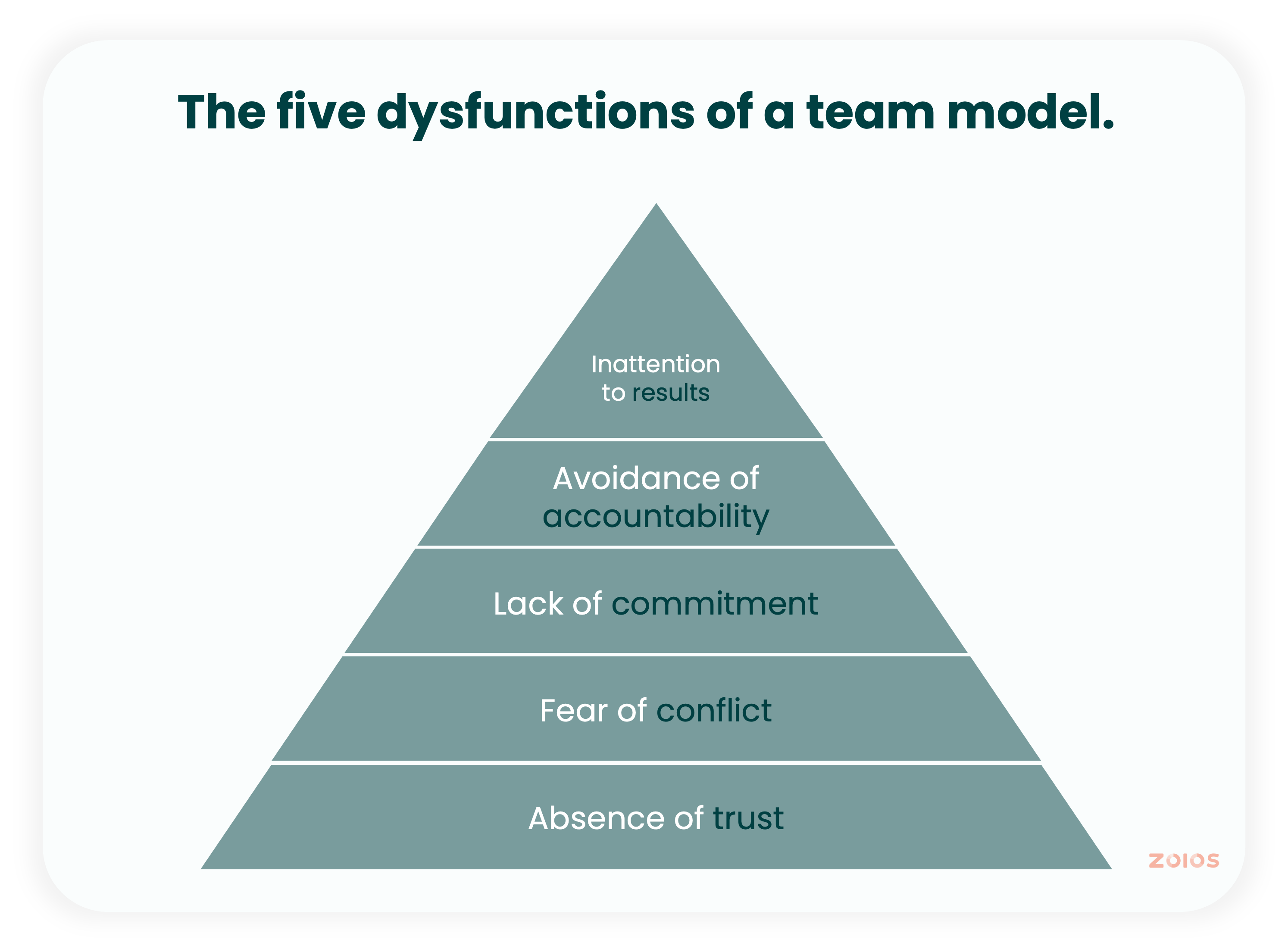
Lencioni's five dysfunctions of a team model (Lencioni, 2015).
According to Stefan Sander, People & Culture Partner at MobilePay, this makes complete sense: "If we can't speak openly and honestly and dare to be vulnerable, then we don't dare to conflict either. It is really important that we dare to disagree and have productive debates about what is not working."
Stefan also explains why this matters: "If I, as your employee, do not dare to state that I disagree with you about a decision, then I will have unresolved dissatisfaction about the decisions you, as a manager, make. And I will be far less committed and less willing to go to great lengths so that we can reach the goal. As soon as we have a shared commitment, we can start holding each other accountable."
Exactly the ability to hold each other accountable, Stefan explains, drawing on Tuckman's model for team development, is the key to a team reaching a stage where they perform and create results.
The Tuckman model illustrates how a team moves through different stages. According to Tuckman, each stage needs to be successfully navigated to reach effective group functioning.
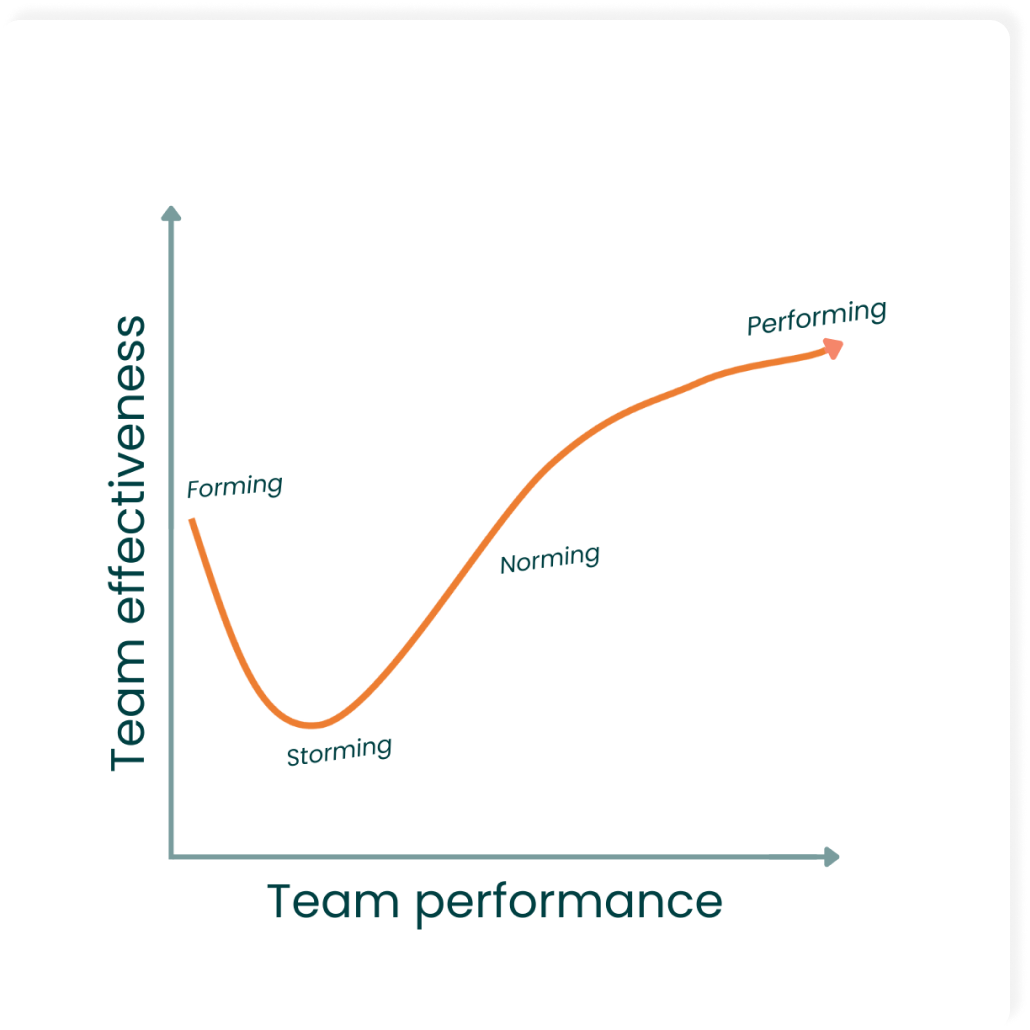
Tuckman's stages of team development (Tuckman, 1965).
Forming. When a team is put together, members get to know each other. They are typically afraid of stepping on each other's toes and want to make a good impression on the new relationships. Performance is therefore typically quite high at this stage.
Storming. After a few months, the team reaches the storming phase, where they discover each other's differences and start to notice the things about other team members that annoy them. Many teams never make it past this stage because they don't have the trust to put into words the things that aren't working.
Norming. To move on, the team starts to form a clear set of norms and ground rules: a social contract with very concrete guidelines for what is appropriate behavior and what is not. An example might be that you should notify the meeting facilitator if you are late. These ground rules are important to cooperate and hold each other accountable, and they determine whether a team moves into the performing phase.
Performing. Here, team members live by their ground rules, fulfill their potential, and reach their goals.
It all comes down to psychological safety. Because you cannot hold each other accountable if there is not the psychological safety necessary to put into words the things that do not work. The key to high-performing teams is psychological safety.
The problem, according to Stefan Sander, is that performance is most often measured by how much employees deliver, how many sales they have made, and how much money they earn for the company. This results in types with certain behavioral traits being held up as role models, even though they may actually be toxic to the culture and to psychological safety, because they only care about their own goals and interests. Trustworthiness is far more important for a team's success than how individual employees perform on KPIs, at least if you want a team that cooperates and pulls together rather than individual performers.
"If we create a culture where we are too proud and shy of conflict to be able to tell our manager and colleagues when a death has occurred in the family, when we haven't slept all night, or when we feel pressured, then there will be far more people who reach a point where they are burned out. And there will most likely be far more long-term sick leave." — Stefan Sander
Better teams make more mistakes?
In addition to mutual accountability, another important consequence of psychological safety is that we learn from our mistakes and innovate better.
Professor of leadership at Harvard Business School Amy Edmondson associates the companies that have psychological safety with those where employees are willing to take the interpersonal risks associated with learning.
Edmondson has been investigating psychological safety for several years. In a research project that aimed to test whether better hospital teams make fewer medication errors, it turned out, to her surprise, that better teams made more errors. Examining the results further, Edmondson found that it was largely a matter of some teams being better at reporting and discussing their mistakes than others. There was a correlation between teams with greater openness and honesty and more reported errors.
So in a team with enough psychological safety to admit mistakes, give each other feedback, and learn and develop, we innovate and perform better.
We also cannot be blind to the fact that we live in a knowledge society where tacit knowledge, knowledge that exists with employees but is not said out loud or written down, is extremely important for organizations. If there is no psychological safety to talk about mistakes, insecurities, and to give each other open and honest feedback, that tacit knowledge disappears as drastically as the people who hold it.
High-performing teams in Danske Bank
In an interview with Stefan Sander, he explains how, during his time at Danske Bank, he helped carry out a study to find out what makes teams perform well.
Based on that analysis, plus additional external studies and theory about team performance, Stefan and his colleagues found that there are eight things that characterize a high-performing team. One of these eight principles, "Healthy team culture," is largely about psychological safety and is, according to Stefan, the most important factor in team performance.
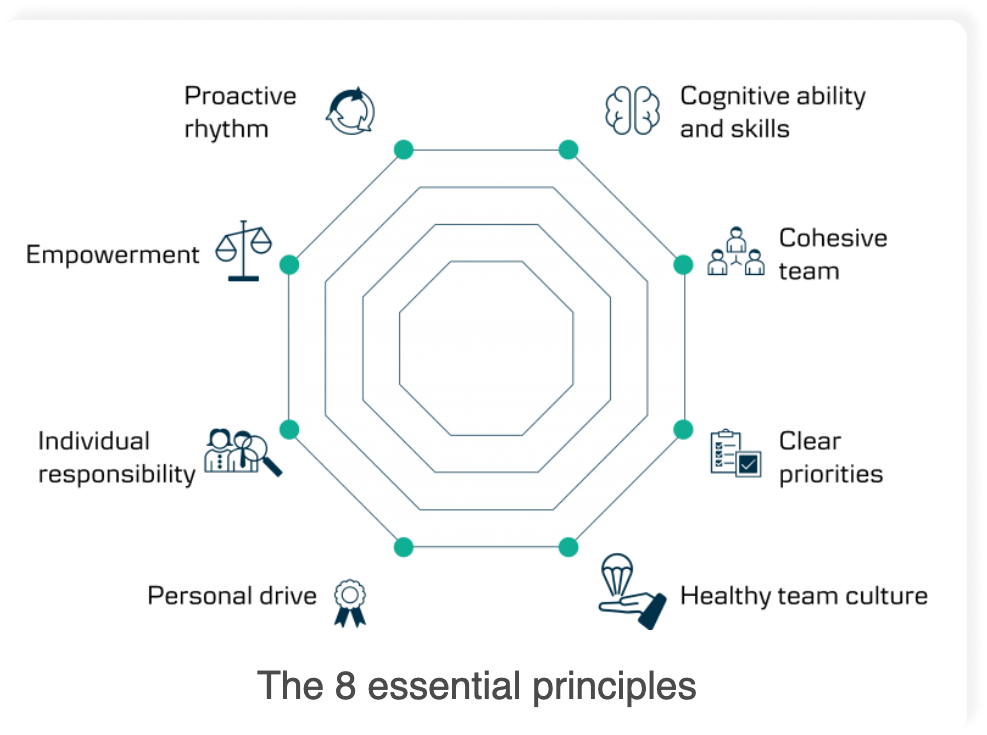
The eight things that characterize a high-performing team.
At Danske Bank, they developed a survey with around 70 questions related to the eight principles, which they sent out to teams in the organization. The aim was to clarify what the respective teams were good at and what they had to work on.
Based on that data, Stefan and his colleagues facilitated a series of team sessions where they worked with the eight factors. In the sessions, they made a great effort to create a safe space where the employees could open up and talk about more difficult things that they would otherwise not be able to discuss.
Stefan tells about a team that, before the session, had scored high on all parameters. Three months after the first team session, they answered the survey again to measure progress. The team scored lower on all parameters than the first time. At first glance, performance looked worse. But Stefan and his colleagues found that the psychological safety of the team had increased. The reason they scored lower was that they were more open and honest about their challenges. Stefan reflects: "We stopped looking at high-performing teams as a number we could put on them, because we found that the value in creating good teams arose in the dialogue and self-awareness about the difficult things."
Half a year after going through a series of team sessions, the participating teams were asked whether the sessions had a positive effect on their behavior and effectiveness. 67% of the 6,000 people who participated answered yes. As for the remaining 33%, the majority were found to have switched teams during the period in question, which indicated how important stable teams are. Otherwise, teams only start off in the forming phase to be disrupted in the storming phase, just to start over again.
So if you want to increase psychological safety, Stefan recommends collecting some data on teams and bringing in skilled facilitators who dare to ask good and uneasy questions. The facilitators do not necessarily have to know the team. In fact, it is often better if they do not, since they have no stake in deliveries and can stay unbiased.
How to create psychological safety: three tools
If you want your team to succeed and create results, start by looking at how you define success. If there is a tendency in your team, or in the company, to evaluate performance based purely on output, the focus has to shift. As a starting point for improving psychological safety, it can be useful to first measure it.
"It would be completely wrong to look at data and numbers regarding team performance in isolation. But data and numbers are insanely good at getting an indication of where there are challenges, and the data can be used to ask some good questions." — Stefan Sander
Three pieces of advice to increase psychological safety:
1. Set the scene
One piece of advice from Amy Edmondson is to "Frame the work as a learning problem, not an execution problem." That involves communicating that it is okay to make mistakes and share them when we do; we learn and grow more by doing this. It also involves encouraging people to share insecurities and worries.
Create the framework for employees to get to know each other and become comfortable on a more personal level. Team-building activities, walks and talks, joint physical activities, social events, or small social traditions in the team all help. Working actively with personality and behavioral preferences profiles is another effective way.
According to Stefan Sander, intimacy and these relationships at work determine whether there is psychological safety: "If we can talk about personal challenges with each other, then it is much easier to talk about work challenges, as the latter is far less sensitive."
2. Acknowledge your own fallibility
In addition to consistently communicating that it is okay to make mistakes, it is particularly important as a leader to show it. Take the lead and be transparent about the challenges and uncertainties you face as a company, and what is specifically challenging for you as a manager.
"If you as a manager dare to show vulnerability, both personally and professionally, you can be sure that it will have a positive impact on your employees' openness. As a manager, you have a lot of influence on the psychological safety within your team, but it takes an extreme amount of courage to take the lead." — Stefan Sander
3. Ask a lot of questions
Ask your team for feedback and let them experience that you value their voice and take it seriously. Respond curiously and with interest when they bring input. Make sure they know you act on their input, or let them know why if you don't. Support them in the challenges, questions, and ideas they raise. This will support them in expressing their perspectives again and again without fear of being judged.
In addition, make sure that, in a safe space, questions are also asked about things that are difficult to articulate. Team sessions are one good vehicle for this, as in the Danske Bank example.
"It's not rocket science. It's very basic, actually. But it's something that is neglected in the very hardcore business world. In reality, it requires something quite low-practical, like an exercise where you sit in a room and ask some questions. And stop splitting the employees' identity into a professional one and a personal one. They are more or less fluid. Some people will disagree with this, but as a fact, there will only be one Stefan in the coffin when I leave Planet Earth eventually. Not HR Stefan, Father Stefan, Friend Stefan. Just one Stefan." — Stefan Sander